

Here's Why the Jackson Area Can't Stop Talking About Them
Walk into a space with a metallic floor and you’ll know it immediately. There’s a depth to it — a shimmer that shifts as the light moves across the surface. It doesn’t look painted. It doesn’t look like tile. It looks like something between liquid metal and polished stone, and people can’t stop asking about it.
In the Jackson area, we’ve seen a significant uptick in homeowners and business owners asking about metallic epoxy floors — and for good reason. The look has gone from niche to mainstream fast, and the options available today are genuinely impressive.
So What Is a Metallic Floor, Exactly?
A metallic floor is typically created using a metallic epoxy system — a two-part coating that incorporates metallic pigments to create swirling, dimensional patterns that mimic everything from molten copper to storm clouds to moon rock. No two floors look exactly alike, which is part of the appeal.
The process involves applying a base coat, then working the metallic pigment layer while it’s still wet — using air tools, rollers, or brushes to create movement and depth. Once sealed, the result is a surface that’s both visually striking and surprisingly durable.
The Colors Driving the Trend
Right now, two looks are dominating conversations: copper and charcoal.
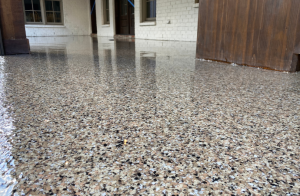
Copper tones bring warmth and richness to a space. Done well, a copper metallic floor has the kind of glow that makes a room feel intentional — like the floor was chosen, not just installed. It works beautifully in living areas, entryways, and retail spaces where you want the first impression to hit hard.
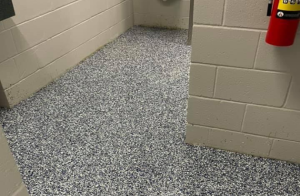
Charcoal is the cooler counterpart — dramatic, modern, and versatile. It reads as industrial without feeling cold, and it pairs naturally with concrete aesthetics that are still very much on trend. Whether at home or in a business setting, charcoal metallic floors tend to complement almost any color palette on the walls.
Beyond these two, we’re also seeing strong interest in pewter, bronze, gunmetal blue, and even mixed-tone blends that pull from several metallic colors in the same pour. The customization possibilities are genuinely wide open.
What Makes These Floors So Practical
Here’s something that surprises a lot of people: metallic epoxy isn’t just pretty — it’s one of the more hardworking floor surfaces out there.
Once properly sealed, metallic floors are resistant to moisture, stains, and heavy foot traffic. They’re seamless, which means no grout lines to clean and no edges to catch debris. In kitchens, breakrooms, showrooms, or garages, that low-maintenance quality matters as much as the look.
They can also be applied over existing concrete in most cases, which keeps installation costs manageable compared to tearing out and replacing what’s already there.
Common Misconceptions Worth Clearing Up
One thing we hear at 33 Dreamcrete fairly often: “Won’t a metallic floor be slippery?” It’s a fair concern. The answer is that the finish can be adjusted. Anti-slip additives are worked into the top coat during installation, giving you the look you want without the hazard — especially important in commercial environments or households with kids or pets.
Another common assumption is that metallic floors are purely decorative and won’t hold up to real use. That’s a misconception worth correcting. When installed correctly with the right primer, epoxy layers, and topcoat, these floors are built for the long haul.
What to Know Before You Commit
Not every concrete surface is an ideal candidate right out of the gate. Cracks, moisture issues, or previously coated surfaces may need prep work before a metallic system goes down. A professional assessment beforehand isn’t just helpful — it’s the difference between a floor that performs and one that peels.
Color selection also benefits from seeing physical samples in your actual space, under your actual lighting. Metallic pigments react differently in natural light versus artificial light, and the way a sample looks on a screen won’t always match what you see underfoot.
The good news: these aren’t decisions you have to make alone. If you’re weighing options and not sure which direction makes sense for your space, we’re happy to walk you through it. You can reach us at 601-906-0699.
Is This Trend Here to Stay?
Trends come and go in flooring, but metallic floors have something the more fleeting ones don’t: they’re genuinely functional. The look is dramatic, but it’s grounded in a coating system that performs. That combination tends to have staying power.
Throughout the Jackson area, we’re seeing these floors show up in places that used to default to polished concrete or standard epoxy — and the response has been consistently strong. Once people see one in person, the conversation usually shifts pretty quickly from “is that real?” to “how do I get that in my space?”
If you’ve been curious about what metallic epoxy could do for your floor, now’s a good time to explore it.
FAQs
- How long does a metallic epoxy floor last? With proper installation and maintenance, metallic epoxy floors can last 10–20 years or more. The topcoat can be refreshed over time to restore the sheen.
- Can metallic floors be installed over existing concrete? In most cases, yes — as long as the concrete is structurally sound and free of significant moisture issues. Surface prep is key to adhesion and longevity.
- Are metallic epoxy floors slippery? They can be if no anti-slip additive is used, but a non-slip texture can be incorporated into the topcoat during installation to make them safe for everyday use.
- What’s the difference between metallic epoxy and standard epoxy flooring? Standard epoxy is typically a solid color or flake system. Metallic epoxy uses pigment particles that create a three-dimensional, swirling depth effect that’s unique to each pour.
- How do I choose between copper, charcoal, and other metallic colors? Lighting plays a huge role. Ask to see physical samples in your actual space before deciding — metallic pigments shift in appearance depending on the light source.